The Himalayas Near the Point Where the Rivers Stop Rising and Start Falling. Only 21 of 40,000 Glaciers Are Watched
A report from Systemiq and three mountain institutes says the range that feeds the Indus, Ganges and Brahmaputra will reach peak water by mid-century. Nearly 200 glacial lakes in India are high risk. Last month a glacier collapse killed at least 1,300.
Tuesday, September 15, 2026/3 min read
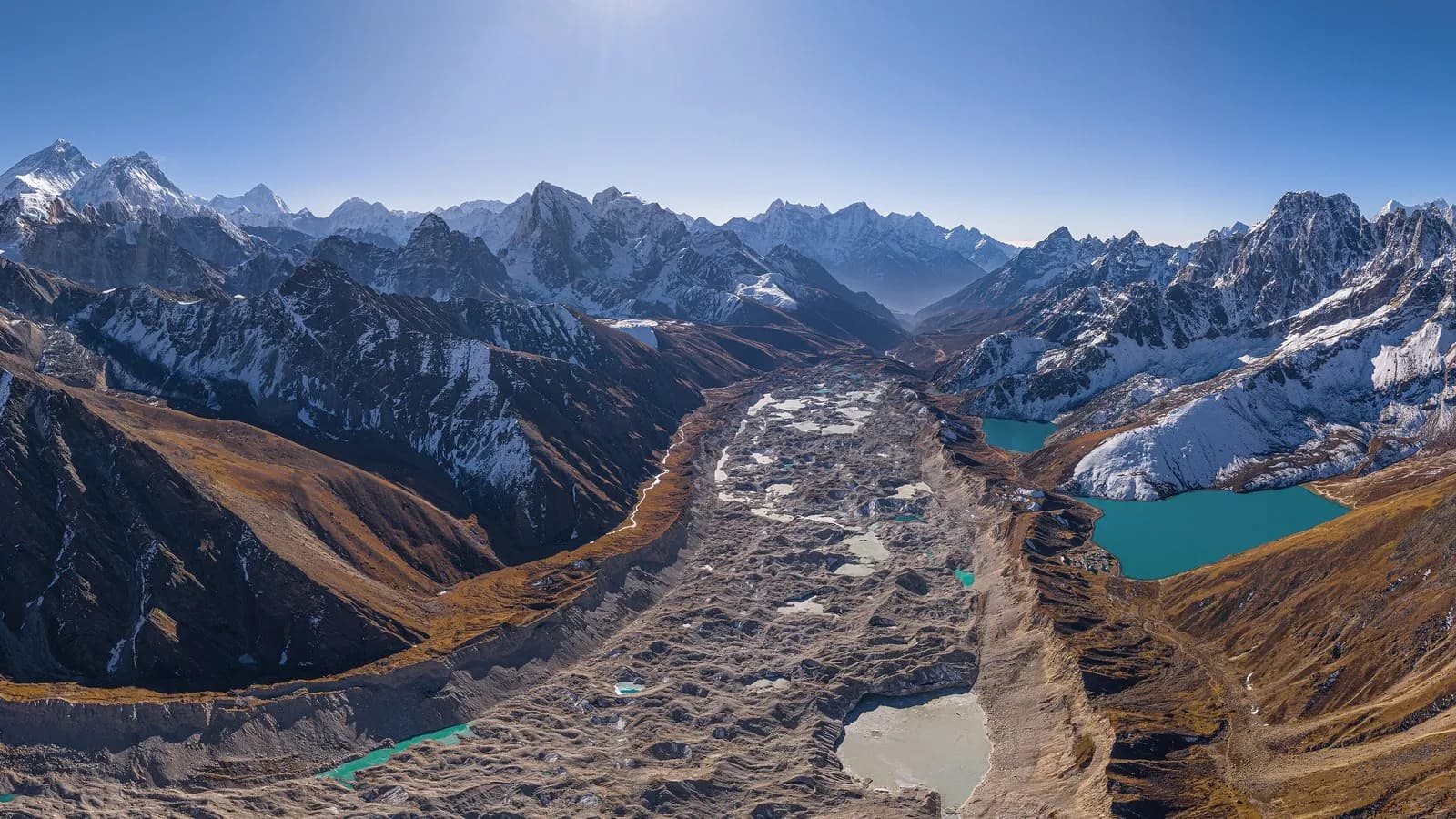
The phrase to learn is peak water. A glacier that is melting faster than it is being replenished sends more water down its rivers each year, not less, until the ice is thin enough that the flow turns and begins a decline that does not stop. For the Hindu Kush-Himalaya, whose ice feeds the Indus, the Ganges, the Brahmaputra and the rivers that water two billion people in South Asia, a report published on Monday puts that turning point at mid-century. It is not a projection for the far future. It is a date inside the working lives of the people reading it.
The report
The work is by Systemiq, a sustainability consultancy, with the Integrated Mountain Initiative, the International Centre for Integrated Mountain Development in Kathmandu and India's G.B. Pant National Institute of Himalayan Environment, and Reuters reported it on Monday morning. Its central finding is that the glaciers are melting faster than they were a decade ago and that the range is approaching a tipping point for water security. Around it are the figures that make the finding concrete. Close to 200 glacial lakes in India are classed as high risk of bursting, 56 of them very high. Only 21 glaciers across the whole region are monitored on the ground, out of an estimated 40,000. The mountains underpin more than a fifth of India's GDP, occupy about 18 per cent of its land and account for about 35 per cent of its natural disasters.
What a glacial lake does
A retreating glacier leaves a lake behind its terminal moraine, a dam of loose rock and ice that was never built to hold anything. When the lake fills past what the moraine can bear, or when ice or rock falls into it, the dam fails and the lake empties down the valley in minutes. The engineering term is a glacial lake outburst flood, and the region has had them for as long as there have been records, but the lakes are larger now and there are more of them. The report's 200 high-risk lakes are in India alone. Nepal, Bhutan, Pakistan and Tibet have their own lists. Late August's glacier collapse, which the report cites, killed at least 1,300 people across Nepal and Tibet with more than 5,300 still missing, and it is the reason the report landed on a front page rather than a shelf.
The monitoring gap
Twenty-one glaciers is the number to hold on to. It means that the largest store of frozen water outside the poles, feeding the most densely populated river basins on Earth, is being tracked on the ground at a density of one station per two thousand glaciers, and that almost everything anyone says about the rate of melt comes from satellites, which see area well and depth badly. It also means that most of the 200 dangerous lakes have no gauge, no early warning and no siren in the villages below them. The report's recommendations, as far as Reuters describes them, are the obvious ones: monitor, drain the worst lakes, move the settlements that cannot be protected, and plan the basins for a future in which the rivers carry less. The last is the hardest, because it requires India, Pakistan, China, Nepal and Bangladesh to plan the same rivers together, and they do not.
We reported last week that August was the joint hottest month ever measured. The Himalayas are where that number becomes water, and then, for a while, more water, and then less. Mid-century is twenty-four years away.
Published in The Outspoken Digest
Editorial desk
Outspoken Digest News DeskReports for The Outspoken Digest across Latest Trends, Sports, Nutrition, Crypto.
Newsletter
The Digest, in your inbox
One edition, sent when it is ready. No noise, and your address is never passed on.
Read Next
More Latest Trends →
Merz Skipped New York to Stay in Berlin. Eight Premiers Back Him, 78 Per Cent of Germans Do Not. Two States Vote Sunday
Sep 17, 2026/3 min read

Von der Leyen Offered Canada a Seat That Does Not Exist Yet: the EU's First Associate Member, With Carney in the Gallery
Sep 17, 2026/3 min read
The House Voted a Third Time to End the Iran War, the CBO Priced It at 38 Billion, and Massie Moved to Impeach Hegseth
Sep 17, 2026/4 min read
Saudi Arabia Stopped Loading Oil at Yanbu, a Houthi Drone Was Shot Down South of Mecca, and Four Ships Crossed Hormuz
Sep 17, 2026/4 min read